Stakeholder management for AI Product managers.
One key responsibility of product managers is stakeholder management. All great product managers understand their stakeholder's needs. These stakeholders are senior management, the sales department, the marketing team, and the development/engineering teams. For an AI product manager they have additional stakeholders, i.e. Data Scientists, Machine learning engineers, and DevOps.
Managing such a diverse group of people is a challenge in itself. In addition to execution skills and customer obsession, AI product managers work with technical and non-technical stakeholders.
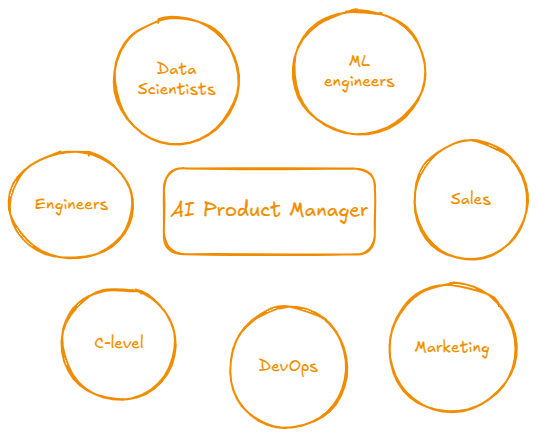
Let's take a deep dive into how such collaboration looks.
Technical Stakeholders
We look at the special stakeholders with which an AI product manager usually interacts. It's important for an AI product manager to understand their roles and responsibilities.
- Data Scientists: Data Scientists solve problems with the data. They create predictive models for problems. They also crunch data to make it more useful for the product. As an AI product manager, you would need to work on the problems with the data scientist that involve structured and unstructured data. For example, Suppose you as a PM, need to understand why certain users are not utilizing a particular product feature. In that case, you can ask data scientists to understand the usage data and find the possible causes. To collaborate with Data scientists, the problem statement must be well-defined and measurable.
- Machine Learning Engineer: ML engineers do not necessarily work on statistical modelling. Although they do work with data, they are mostly specialized in the different aspects of machine learning. ML engineers work with deep-learning methods and complex neural network-based models.
- DevOps: Collaboration with DevOps, SREs, and SysAdmins is crucial for efficiently and reliably delivering AI/ML features. AI product managers often drive MLOps initiatives, define infrastructure needs, and, with the help of DevOps, ensure reproducible environments for training & inference. Just like traditional features, an AI product manager needs to communicate release plans and coordinate updates.
- Software Engineers: The AI product manager collaborates closely with software engineers by providing requirements for AI features and translating machine learning research into actionable engineering tasks. The PMs support deployment efforts by coordinating model serving, APIs and backend systems from multiple teams.
It is also important for AI product managers to work with non-technical stakeholders. Let's take a brief look at what this looks like.
Business Stakeholders
- Sales: AI product managers work with the sales teams to ensure they understand the value and capabilities of AI features. They provide sales enablement materials, help craft compelling use cases, and join client calls when technical or strategic input is needed. It is important to capture the feedback from the sales to understand customer pain points and align the product roadmap accordingly.
- Marketing: With marketing teams, AI product managers position AI features efficiently in the market. They help create messaging that balances technical accuracy with customer benefits. They also work with marketing to track adoption and user engagement for AI-powered offerings.
- C-suite: It is very important that the AI product managers align with the C-suite. PMs can provide strategic insights into how AI can drive business value. They align product direction with company goals, present updates on AI initiatives, and identify opportunities for innovation and competitive advantage. The AI product manager should ensure leadership understands the potential and limitations of AI capabilities.
To be a great AI product manager, cross-team collaboration is a must. Understanding the nature of the work and stakeholders is crucial to a product manager's success.