Introduction to AI Product Manager.
In recent years, Artificial Intelligence (AI) has impacted every aspect of products and services. From customer support to software development, AI is disrupting traditional processes. Needless to say, it has also impacted product management. From writing PRDs to product documentation to marketing emails, AI is creating a significant shift in product management.
This shift demands a change in the mindset of how traditional product management is done. With AI in the passenger seat, product managers need to understand what AI entails and elevate themselves into a new role that would be more or less called AI Product Manager. But does an AI product manager mean a person with a product manager who uses AI, or is it more than that? What would be the key factors in such a role?
Introduction
Simply put, an AI product manager is
Someone who understands and uses AI to develop, deploy and continuously improve AI-driven products and services.
The key term here is ‘understand’. AI is a vast field, and it's helpful when someone understands how it works, what it can do, and how it impacts their products or services.
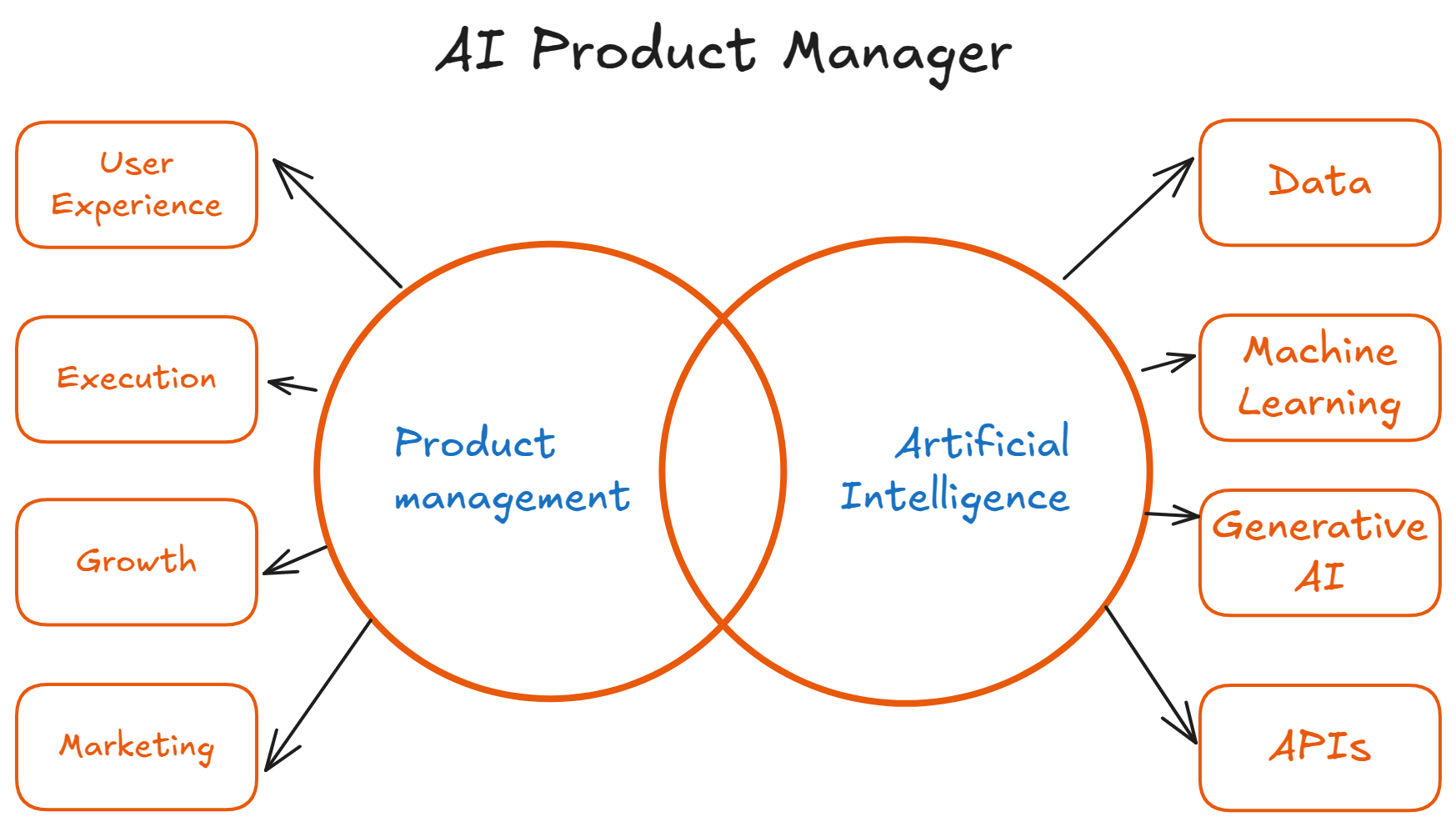
But it’s not as simple as the above definition says. An AI product manager also leverages data analytics, machine learning, natural language processing, and other new technologies and methods to create and enhance their products and services. These new creations or enhancements can be either in the form of new products that offer AI capabilities or existing products that use AI techniques to improve products.
The product-building aspect of an AI product manager is still relevant. The AI product managers still work with stakeholders like UX designers, software engineers, and sales & marketing, and they also have to work with data scientists, machine learning engineers, and probably prompt engineers in future.
Let’s briefly examine the key responsibilities of an AI product manager.
Key Responsibilities
- Understand AI: PMs should understand the basics of AI to communicate effectively with different stakeholders. Although they are not expected to be experts in everything, foundational knowledge is helpful.
- Identifying use cases: One critical task of the AI product manager is identifying use cases with a high-value impact on the product. It's not easy to develop ideas. The PMs can understand their product's drawbacks and examine how AI can help solve them. This could be one of the starting points.
- Data Strategy: At the end of the day, an excellent data strategy boils down to the data. Having a strategy around data collection, extraction, and transformation, usage that helps drive the success of the AI features in the product. The data from the product can be used to train the AI models. AI product managers should also make data quality their priority.
- Cross-functional team collaboration: Collaboration with multiple stakeholders is important, and the AI product manager's responsibility is essential to ensure that the information is correctly understood by both technical and non-technical stakeholders. They should try to understand the technicality of data scientists, machine learning engineers, and business terms with sales, marketing, and financial stakeholders.
- Product Lifecycle Management: This is no different than the traditional management of the product lifecycle. AI product managers should own and manage ideas, conceptualize, and execute delivery and scaling of the product or feature.
- Ethics and Fairness: Using AI comes with its own shortcomings. For example, LLMs are prone to hallucination or biased results. This can cause significant issues for the users. An AI product manager should be aware of the fact that it can produce false results and should prepare for it.
With great responsibilities come great challenges, too. Although working as an AI product manager is rewarding, it comes with its own set of challenges. From data quality to regulations, challenges keep occurring as the field keeps evolving, and every AI product manager should work on a plan to tackle and mitigate them.
Challenges for an AI Product Manager
- Quality & Performance: All AI products rely on data(mostly), and the better the data, the better the models can use it and be helpful. If the model is trained on bad data or uses wrong data to generate output, it affects the quality of the product. As a PM, handling data quality and model performance should be one of the action plans. Questions such as - where does the data come from? Does the data have any PII (personally identifiable information) that can lead to bias, etc?
- Data Privacy and Security: Any data that flows through the product and interacts with an AI model should follow strict protocols on security and privacy. If the product belongs to a well-regulated industry like pharma, banking, or insurance, AI product managers should understand the regulatory compliance related to the industry they belong to. The AI PMs should make plans for various challenges when it comes to data privacy and security, such as user consent & transparency, third-party data sharing risks, data breaches, bias and fairness risks, etc. The PMs should work with various stakeholders to mitigate these challenges.
- Being technically aware: Although AI is not a new subject, the adoption rate has increased in the past few years. The field is constantly changing, and new techniques, models, and applications keep buzzing every few months. It‘s hard to keep up with it. It's not required for an AI product manager to have deep dive knowledge on all the topics, but being aware of the high-level technical details is good. The challenge comes from being able to grasp this knowledge and apply it to the products.
Having noted the responsibilities and challenges for an AI product manager, let’s look at some of the skills required for becoming an AI product manager.
Skills of an AI Product Manager
- Technical skills: As discussed in a few points above, having technical skills in the areas of data analytics, AI, and machine learning is beneficial. While not necessarily deep-dive knowledge, having fundamentals makes communication with stakeholders effective.
- Business acumen: AI Product managers should clearly understand the business objectives along with the technical skills of AI. They must balance customer pain points and market trends with AI-powered features.
- Project management: Strong execution skills are required when working on AI projects. Managing constraints like budget, resources, and timelines, along with expectations and cross-functional team coordination, is essential.
- Communication: AI Product managers serve as a bridge between technical and non-technical folks. The ability to communicate effectively on technical concepts is vital for the success of products and services.
AI product management is an exciting, challenging field. Like other product managers branch, this field comes with the same responsibilities of product manager and evolving field of AI. For aspiring PMs, now is the right time to dive into and master the skills required for a fast-paced and ever-changing industry.